 Jul 31, 2026
 S2C Prodigy helps SoC teams run longer software workloads, connect real interfaces, and validate system behavior before first silicon.
Software-based RTL simulation remains indispensable for block-level verification and detailed debug. Runtime becomes a limiting factor, however, when teams need to boot an operating system, run long software regressions, or exercise realistic traffic across a large SoC. These workloads can require billions or trillions of design cycles, making simulation alone impractical.
Hardware emulation extends verification into early system-level RTL, with broad visibility and repeatable debug at MHz-class performance. As the RTL stabilizes, FPGA prototyping becomes the high-speed bridge to firmware, operating systems, real interfaces, and system-level workloads.
The S2C advantage: Prodigy combines scalable FPGA prototyping hardware with automated partitioning and control, multi-FPGA debug, host connectivity, ready-to-use interfaces, and enterprise resource management.
20+ YEARS | 600+ CUSTOMERS | 4,000+ SYSTEMS INSTALLED | GLOBAL SUPPORT
Emulation and FPGA prototyping remain distinct. Emulation is optimized for early RTL verification and observability; FPGA prototyping is optimized for runtime speed, software execution, and physical connectivity. For many projects, the handoff to prototyping is where hardware/software integration begins to resemble the final system.
Development need | Hardware emulation | S2C Prodigy FPGA prototyping |
Primary optimization | RTL observability, verification semantics, repeatable debug | Runtime performance, software execution, physical interfaces |
Best-fit workloads | System-level RTL debug, regressions, assertions and coverage where supported | OS and firmware bring-up, long regressions, real-world traffic and system validation |
Debug approach | Broad visibility and deterministic debug | Selective instrumentation, deep trace and multi-FPGA debug |
Build emphasis | Predictable compilation and rapid verification turns | Synthesis, partitioning, routing, timing closure and interface integration |
The objective is not to make emulation and prototyping identical. It is to reduce friction as designs, interfaces, test environments, and software workloads move through the pre-silicon flow. Prodigy provides the higher-speed environment for the stages that benefit most from long execution runs, real I/O, and software-driven validation. S2C is releasing a dual-mode solution for prototyping and emulation pretty soon.
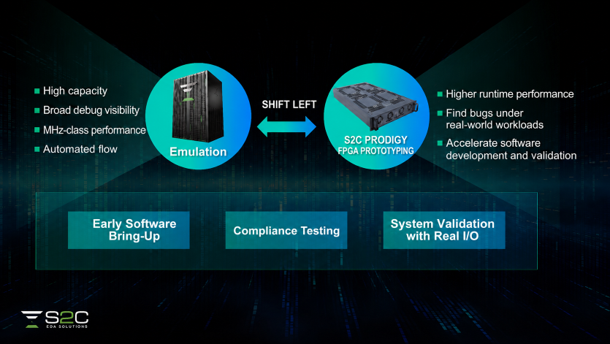
Figure 1. S2C Prodigy extends the pre-silicon workflow into higher-speed software bring-up, compliance testing, and system validation with real I/O.
Prodigy is more than a prototyping board. Its hardware platforms and toolchain address the practical work required to turn RTL into a reusable system-validation environment.
· Scalable prototyping platforms. Prodigy Logic Modules, Logic Systems, Logic Matrix platforms, and the latest S8 family support a wide range of design sizes and deployment models. The S8-100 supports up to 100 million ASIC gates per FPGA and up to 400 million gates in a four-FPGA system.
· Prodigy Player Pro. An integrated environment for compilation, automated and guided partitioning, debug setup, configuration, monitoring, and remote system control.
· Multi-Debug Module Pro. Concurrent deep-trace debugging across multiple FPGAs helps teams investigate system-level behavior without treating each FPGA as an isolated debug target.
· Prodigy ProtoBridge. High-bandwidth transaction connectivity between a host computer and the device under test supports hardware/software co-development and hybrid validation.
· Prototype Ready IP. More than 100 ready-to-use daughter cards, speed bridges and memory model reduces custom interface bring-up with pre-tested cards, integrated rate adaptation, and reference flows.
The commercial value comes from solving the implementation problems that otherwise delay prototype availability and limit its usefulness.
Customer requirement | Prodigy capability | Customer value |
Large-design bring-up | Scalable hardware plus Player Pro automated and guided partitioning | Fewer manual partitioning steps and a faster path to a runnable prototype |
Debug across partitions | Multi-Debug Module Pro with concurrent multi-FPGA deep trace | Better system-level visibility and faster root-cause analysis |
Real interfaces | 100+ Prototype Ready IP daughter cards, speed adaptors, and memory model | Earlier connection to memories, peripherals, networks, and target systems |
Hardware/software co-development | ProtoBridge transaction connectivity between host and prototype | Flexible partitioning of validation workloads between software models and hardware |
Shared enterprise deployment | Neuro centralized access, allocation, monitoring, and resource management | Higher platform utilization and easier access for distributed project teams |
Once the RTL is stable enough for a prototype build, firmware, drivers, operating systems, and application software can begin running before first silicon. Teams can exercise real interfaces, run longer regressions, reproduce software-driven corner cases, and prepare system demonstrations while design changes are still comparatively inexpensive.
Earlier integration reduces late-stage surprises and improves readiness for silicon bring-up. The approach is especially valuable for CPU and RISC-V, AI and HPC, automotive, communications, and cloud-oriented SoCs with large designs, long software workloads, or demanding I/O.
Bring S2C a representative design partition, target interface configuration, and software workload. S2C's engineering team can help identify an appropriate Prodigy configuration and assess capacity, partitioning, debug, host connectivity, memory, and real-I/O requirements.
START A PRODIGY EVALUATION | marketing@s2ceda.com | www.s2cinc.com
Product capacity figures are maximum vendor specifications. Actual usable capacity and runtime performance vary with FPGA configuration, design content, partitioning, instrumentation, interfaces, and workload.

 Back to list